
Biggin Hall Country House Hotel
Biggin-by-Hartington , Buxton , Derbyshire, SK17 0DH, United Kingdom

Email: enquiries@bigginhall.co.uk
Tel: 01298 84451

Biggin Hall History

biggin_hall_aerial_view.jpgbiggin_hall_lawn_view_cropped.jpgbiggin_hall_house_front_cherrypicker.jpg
 Biggin Hall History

The Village of Biggin by Hartington, and its Hall and Grange
 
In Derbyshire , at least, the word ‘BIGGIN’ means a building, but when the first structure was built that is difficult to determine. There is no mention of any kind in the Doomsday Book of 1186 and it would appear that the area, together with nearby Heathcote was includedin the Manor of :-
 
            Land of Henry De Ferrers
                        “In Hortendun Godwin and Ligulf had (in Edward the Confessor’s time) 2 caracates of Land taxable.
                        Land for 2 ploughs. Waste.
                        Meadow 16 acres; Underwood 3 furlongs long and 2 wide.
                        Value before 1066 40’s
 
            Not a large holding even for those days and it is probable that the area of High Hartington comprising Heathcote and Biggin had not even been cleared or ‘intaken’ from the moors.
 
The earlist hint of development in the area is from a grant to the Abby of Garendon, (founded in 1133) near Loughborough, when Willian De Ferrers confirmed the grants of his Father and Grandfather of the enclosed land at Heathcote, and pasture for 300 sheep there, five cows, one bull and six oxen, given by his father (William, son of Robert, Earl of Derby), but to this ‘added another piece of enclosure therto, with pasturage for 300 mor sheep at six score the the hundred, and for seven more cows.’ (Dugdale’s Monasticon.v.5. ii)
 
            It seems probable that this new enclosure was the start of Biggin. The date of this is not known but the grant was confirmed by Edward III in 1341 (Charter in the Cartulary of the Abbey).
 
            Daniel Dakeyne, the eminent of 18th Century historian, quoting Latine’s “Santa Maria de Geroldina” says that the Monk of Garendon built the Grange at Biggin. He also records in his notebook that in 1429 Richard Delkyn or Dawkyn was ‘Praepostius’ of Hartington i.e. Steward of the Grange for the Abbey.
 
            This same Richard Delkyn of Biggin and Hatton is given the ‘Return of Gentry, 12 Henry VI (1434) as holding lands qualifying him for Knighthood. (one Knights fee = 4 hides or 480 acres.) How much of this Land lay in Biggin and how much in Hatton, near Tutbry Castle, is not specified, but any land owned privately in Biggin would be distinct from that of the Abbey.
 
            Richard was a member of a family established in Chelmortan  about the middle of the 14th Century and which held lands widley scattered over N. Derbyshire from Beaurepaire (Belper) to Fairfield and which, in the 15th Century branched into Eat Yorkshire. Richard’s decendents, however, continued to be associated with Biggin untill, at least the end of the reign of Jame I.
 
            In 1492 John Dalkyn ‘Of Biggin Grange’ is recorded as
Praepostius of Hartington.
 
             At the dissolution of the monastries, Robert Dakyns, eldest son of John Dalkyn who had inherited the family holdings, (Richard was his great-grandfather), became Crown Steward of the Manor of Hartington, as his Kin in Chelmorton had with respect  to the grange lands of Pilsbury and Cronkeston, a little further up Dove Vally, which had been  the property of the Abbey of Merevale in Warwickshire.
By 1535 the crown had confirmed full ownership of these last to the family. How much of the manor of Hartington  was the property of John is difficult to determine but he owned at least half from his marriage to Alicia ge la Pole, daughter of Sir John Pole and joint heiress with her sister Lucia, wife of Sir Henry Sacheverrell Esq.
 
            John died in1506 leaving two known sons – Robert, already mentioned, and Thomas. The latter lived at Hartington and we have records of him serving upon Manorial Courts in the area until, at least 1524. Robert, however took his father’s place at Biggin as preapostius. He married Agnes FitzHerbert (nee’ Berisford), widow of Sir George FitzHerbert of Tissington therby adding to the ties between the Dakyn families and many other of standing in the district.
 
            Another individual born at Hartingon at this time, who may have been a third son of John Dalkyn and Alicia de la Pole was a William Dakeyn (d. 1530),- the “Gugliemus” commemorated in the original upper part of the memorial tablet above the pulpit in Ashover church.  It is noteworthy because it claims, falsely, that he was the Norroy Herald. The memorial was most probably erected by his notorious grandson, another William adn black sheep of the family. He was twice prosecuted for selling false patents of nobilty, losing an ear in the pillory on the first occasion but in 1597 being pardoned by the earl of Essex, sitting in the Star Chamber in exchange for a detailed confession.
 
            The son of Robert of Biggin, another John, together with Henry Sacheverrel was in 1535, involved an an Inquisition Postmortem in the Duchy of Lancaster Pleadings Court when the title to lands in the manor was challenged by a Robert Rowbotham. This indicates that Robert was dead by that time.
 
            Some of the lands in the Biggin/ Hartington area were at the dissolution, sold to Thomas Manners, first Earl of Rutland, including it appears, the site of the monasticfoundation itself. Where the praepostius himself lived before and after this is not known but it is reasonable to assume that he lived in th Hall and continued to do so. Cetrtainly Dakins were to remain titled ‘of Biggin and Hartington’ for another hundred years.

            A further important liason was created by the second John, when, in 1541, he married Dorothy Needham of Thornsett and Snitterton, in Darely Dale. His acquisition of the Old Manor House of Snitterton, about the time of the Armada marks the point at which the main part of the family left Biggin. Other members of the family, however continued to live there: Richard, the eldest son of John of Snitterton, being involved as late as 1593 in another dispute over title to property in Bigginin the Duchy of Lancaster Court of Pleas, claiming, with a Roger Webster – presumably a relative by marrriage. “Title by Descent”.
 
            Soon after this – between 1593 and Richard’s death in 1611, Biggin was sold along with other properties to provide the capital to buy Stubbin Edge Hall near Ashover.
 
            Life in Richard’s time was somewhat perilous. Not only had he married in 1570 a prominent Catholic – a lady in waiting to Mary Queen of Scots, no less- Katherine Strang or Schang of Edinburgh, but adjoining lands in Biggin Grange and Heathcote (High Hartington) were owned by the Babingtons of Dethick (near Matlock), a family deeply involved in the secret Catholic resistance of the period.
 
            Anthony Babington (1561 - 1568) a contempory of Richard Dakeyne was to become fattaly involved in the spanish plot to assassinate Queen Elizabeth and perish in the scaffold an Grays Inn as a traitor. That he knew the Dakyns well is undoubted. As a boy he had served as page to Mary during her imprisonment in Sheffield Manor where Katherine Shang was in attendence. It is said that it was there that he concieved the “ardent devotion” which ultimately led to his execution. In a will made at Sheffield before she was moved to Chatsworth, Mary left Katherine a bequest of 400 Marks-(£133, 6s,8d). It is doubtful whether it was ever paid. The claim that Katherine attended Mary on the scaffold is clearly apocryphal: she had been busy raising half a dozen children over the previous fifteen years in Biggin and Snitterton. It was not untill 1595 that Elizabeth granted Katherine letters patent as a “Free Denizen in England”. The comment upon this document in the british Museum Manuscripts by Kerry , the antiquarian, are clearly inacurate although romantic.
 
            It was Katherine Schang’s son – another John who was disinherited by his father for reasons unknown but considered to be romantic. He became known as John of Bonsall.
 
            Dakyns continued to live on in Biggin for we have another John ‘of Hartington and Biggin’ being widowed in 1620 and a sister or daughter being married in 1627. In Hartington itself, entries in the parish register continue until 1633 when the death of old Katherine Dakyn (sen) apperently severs the connection with the area.
 
            The Lordship of Biggin in the early 17th Century was in the hands of the Duke of Buckingham who had purchased it from the Earl of Rutland  and in 1689 the site of the Grange and its adjoining lands were sold to Sir Ambrose Phillipps. It’s subsiquent history should be outlined in it’s deeds. In 1912 the grange was taken over and farmed by Mr Francis Dunn. The existing house appears to be of late 18th Century origin but requires a detailed survey to recognise and identify earlier structures
 
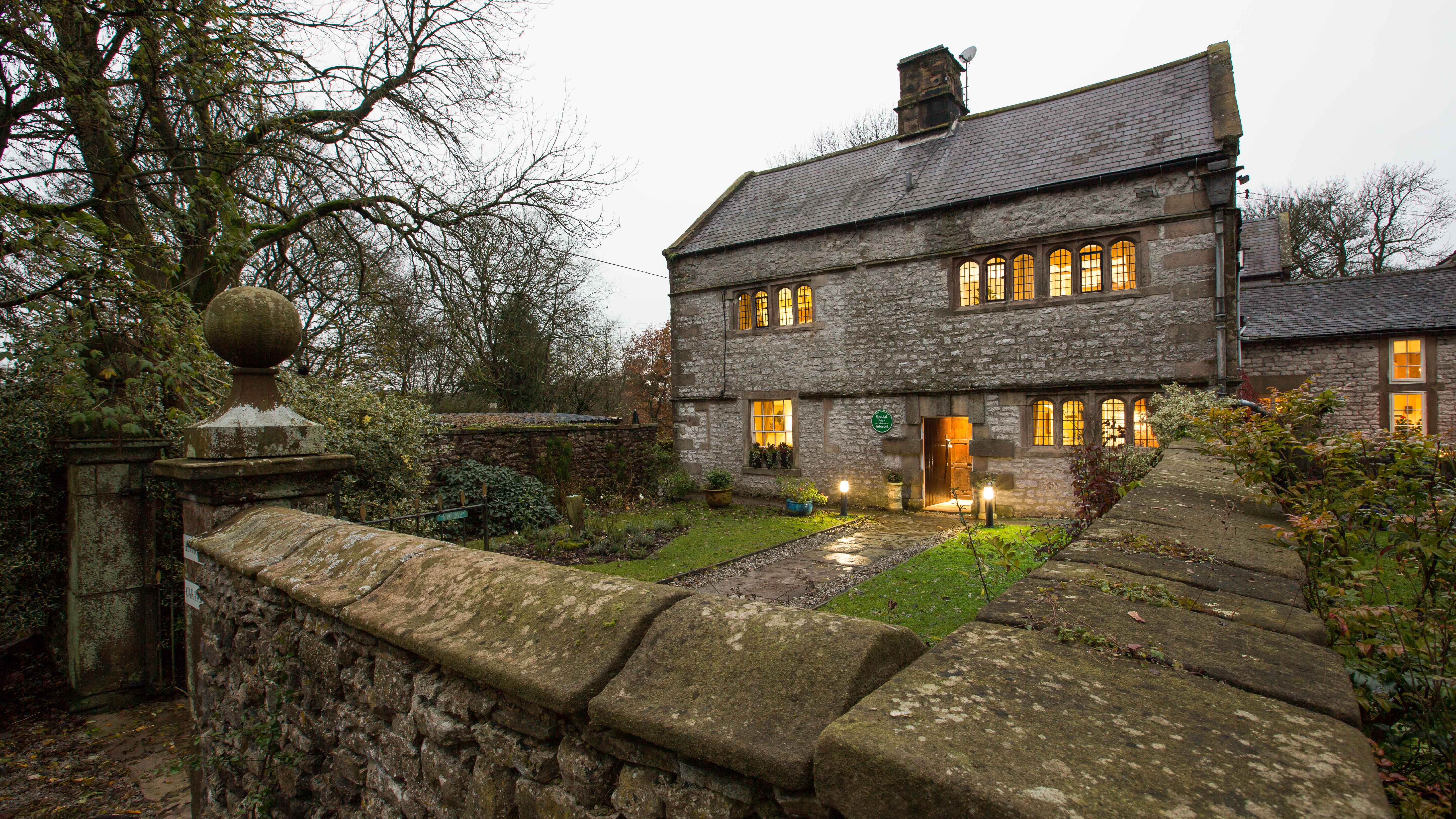
            It is not known whether the present Biggin Hall stands upon an ancient site or earlier foundations and this too requires a careful survey. The general style of the house conforms to a local tradition of Derbyshire manor-house which was common from Tudor times and which resembles in its forms and techniques the familiar Cotswold structures of the same period but with more massive aspect due to the local climate and the use of gritstonewalling and ponderous stone slates for roofing instead of the more usual, smaller, Colley-Weston type.
 
            The rustication around the doorway is perhaps more typical of the Mannerist style of the early Stuart period which may be seen at its most florid in the ‘New Range’ at Bolsover Castle. The roof does not appear to be original but of 19th Century imported slates and it is very probable that the main house has undergone repeated refurbishments over the centuries. It would make an interesting historical study.
 
Research is continuing
 
Note: The spelling of  names of places and people before the late 18th Century is purely arbitrary and according to the whim of the particular clerk, often merely phonetic.                    
 
In a single document, for example- the will of John Dakyn of Biggin, Hartington, Heathcote and Snitterton, there are four different spellings of the name, and Biggin can be found spelled Bigging or even Bigginge in many documents and maps.
 
biggin_hall_beresford_dale_bridge.jpg

Enjoy a Budget Seasonal Break

Biggin Hall can offer a high standard of hotel accommodation at seasonal bargain prices. The beauty of the Derbyshire Peak District National Park with its spectacular limestone gritsone terrain has a special appeal in the Autumn & Winter seasons. Click here to view our current offer.

 
Get Adobe Flash player

©copyright Stack Photo Gallery
The Observer - Biggin Hall 1st of 20 Great Hotels for WalkersThe Good Hotel Guide 2010
Copyright © Biggin Hall Country House Hotel 2012. Peak District Hotels and cottages by Peak District Online.co.uk